

Did Email Really Generate That Sale? Understanding Email Marketing Attribution


Your email platform says a campaign generated £12,000 in revenue. Google Analytics says email generated £7,000. Your ecommerce platform reports something different again.
So which number is correct?
Possibly all of them, according to their own rules.
Possibly none of them, if you are trying to work out whether the email actually caused £12,000 of additional sales.
This is the problem with marketing attribution. Every platform has its own way of deciding which channel receives credit for a sale. The resulting figures can look reassuringly precise, but the journey behind them is rarely as clear as the dashboard suggests.
Email attribution is still useful. You just need to understand what it is measuring before making decisions based on it.
What is email marketing attribution?
Attribution is the process of assigning credit for a conversion to one or more marketing touchpoints. In email marketing, that conversion might be:
A purchase
An enquiry
A booking
A subscription
An account registration
Another action the business considers valuable
If someone clicks an email and buys a product shortly afterwards, giving email some credit feels reasonable. The difficulty is deciding how much credit it deserves. The customer may have already seen a paid advert, visited the website, read reviews, compared several products and spoken to a friend before clicking the email.
Email might have introduced the product. It might have reminded the customer. It might have provided a discount. It might simply have been the most convenient route back to a purchase they had already decided to make.
Attribution records the route that receives credit. It does not automatically prove what caused the customer to buy.
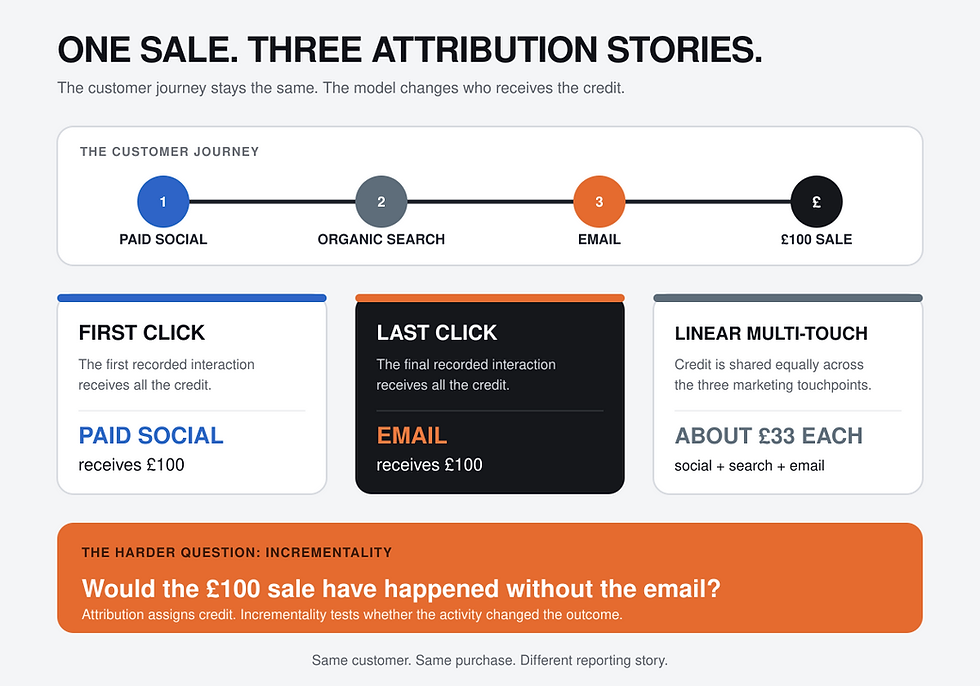
A simple customer journey
Imagine someone discovers a clothing brand through an Instagram advert.
They visit the website and look at a jacket but leave without buying it. A few days later, they search for the brand on Google, read some reviews and sign up for email to receive a first-order discount. They add the jacket to their basket but still do not complete the purchase. The next morning, they receive an abandoned basket email, click the link and place the order.
Which channel generated the sale?
Paid social introduced the brand.
Google helped the customer return.
Reviews built confidence.
The email discount made the price more appealing.
The abandoned basket email provided the final reminder.
A last-click model is likely to give email the credit because it was the final tracked interaction before the purchase. That does not mean email single-handedly created the sale. It means email was the last recorded step. That distinction matters.
What is last-click attribution?
Last-click attribution gives all the credit to the final marketing interaction before a conversion.
If a customer clicks an email and then places an order, email receives 100% of the attributed revenue. The model is easy to understand and useful for identifying which channels often close a sale. It is also widely used because it produces a clear answer, even when the real journey is anything but clear.
The main weakness is that it ignores the influence of earlier touchpoints. A customer could discover a business through a podcast, see several social posts, visit through paid search and eventually purchase after clicking an email. Last click gives the entire sale to email.
This can make channels used near the point of purchase look disproportionately successful. Email, branded search, retargeting and direct traffic often benefit because customers use them when they are already familiar with the business.
Meanwhile, the channels that created the initial interest receive little or no credit.
If a business makes budget decisions using last click alone, it may reduce investment in the activity that creates demand and put more money into channels that mainly collect it.
What is first-click attribution?
First-click attribution does the opposite.
It gives all the credit to the first recorded marketing interaction. In our jacket example, paid social would receive the sale because the Instagram advert introduced the customer to the brand. This makes first click useful for understanding which channels bring new people into the customer journey.
It also has an obvious weakness.
The first interaction may have happened weeks before the purchase and played only a small role in the final decision. Everything that happened afterwards is ignored. First click tells you how the tracked journey began. Last click tells you how it ended.
Neither gives you the full story.
What is last non-direct click?
Last non-direct click gives credit to the last identifiable marketing channel before the customer converts, while ignoring direct visits.
For example, a customer might click an email on Monday, return by typing the website address into their browser on Wednesday and then buy. A standard last-click model could give the sale to direct traffic because that was the customer’s final visit. Last non-direct click would ignore the direct visit and award the sale to email.
This can be helpful because direct traffic does not always explain how demand was created. It can simply mean the analytics platform could not identify another source for the visit. However, it still gives all the credit to one channel.
Shopify, for example, allows businesses to compare first-click, last-click and last non-direct click reporting. Each model can produce a different view of the same customer journey because each one answers a different question. Shopify explains its attribution models here.
What is multi-touch attribution?
Multi-touch attribution divides credit across several interactions.
Instead of giving the full value of a £100 order to the final email click, a multi-touch model might share that value between paid social, organic search and email.
Different models divide the credit in different ways.
A linear model might give every touchpoint an equal share. A position-based model might give more credit to the first and final interactions. A time-decay model might give more credit to the interactions closest to the purchase.
Data-driven attribution uses the available customer data to estimate how much each touchpoint contributed. Google Analytics 4 uses data-driven attribution as its default reporting model and calculates credit based on the observed paths within the property. Google provides an overview of its current attribution approach here.
Multi-touch models acknowledge that customers rarely make decisions after one interaction.
They are still models.
They can only assess the activity that has been tracked. They cannot reliably account for every offline conversation, untracked device, private message, word-of-mouth recommendation or moment when someone saw an advert without clicking it.
A more sophisticated model can provide a better estimate. It does not turn the estimate into unquestionable fact.
Why does your email platform report more revenue?
Email platforms are designed to demonstrate the value of email. Google Analytics is trying to understand activity across several channels.
Your ecommerce platform has another view of the journey.
Each system uses its own attribution rules, tracking methods and lookback windows. That is why the figures often disagree. A platform may attribute a sale to email when someone:
Opens an email and buys within a set period
Clicks an email and buys within a set period
Receives a message and later converts
Interacts with several messages before buying
The exact rules depend on the platform and the account settings. At the time of writing, Klaviyo uses a last-touch attribution model for new accounts, with a default five-day lookback window for email clicks and opens. These settings can be changed. Klaviyo documents its attribution settings here.
This means a customer could open an email, visit the website separately four days later and place an order. If the purchase falls within the configured window, Klaviyo may attribute the revenue to email.
That does not mean the platform is making the figure up. It means the number has been calculated using Klaviyo’s attribution rules.
Another platform using a different model or a shorter window may reach a different answer.
Attribution windows make a big difference
An attribution window is the period after an interaction during which a conversion can still be credited to that interaction.
Imagine two businesses send the same email.
One uses a one-day click attribution window. The other uses a five-day window.
A customer clicks the email and purchases three days later.
The first business may not attribute the sale to email. The second one probably will.
Nothing about the customer journey changed. Only the measurement setting changed.
Longer windows tend to produce more attributed revenue because there is more time for a customer to convert. Shorter windows provide a stricter view but may understate the influence of products with a longer buying cycle.
There is no universal window that suits every business.
Someone buying a £20 skincare product may decide quickly. Someone booking an expensive holiday, choosing business software or buying furniture may take considerably longer.
The window should reflect the likely decision-making period rather than whichever setting produces the most attractive report.
The problem with open-based attribution
Open-based attribution gives email credit when a recipient opens a message and later converts within the attribution window, even if they never click it.
In theory, this recognises that an email can influence behaviour without generating a click.
In practice, email opens have become much less reliable.
Open tracking generally depends on a small tracking image loading when the recipient views the email. Privacy features and email clients can interfere with that process.
Apple’s Mail Privacy Protection prevents senders from reliably determining whether someone has opened an email. Apple explains the privacy feature here.
An email platform may therefore record an open that does not reflect a deliberate human action. If that person later makes a purchase, the platform could attribute revenue to an email the customer may never have read.
This does not make open data completely useless. It does mean open-based revenue should be treated with caution.
Clicks provide stronger evidence of engagement because the recipient has actively selected a link. Even then, a click proves that someone interacted with the email. It does not prove that the email was solely responsible for the purchase.
Email can be overcredited
Consider an existing customer who buys the same products every month.
They receive a campaign email, open it and then place their usual order three days later.
Depending on the platform settings, the full order value could be attributed to email.
Would the customer have purchased anyway?
Possibly.
The email may have brought the purchase forward, increased the order value or reminded them at exactly the right time. It may also have had no meaningful effect. Attributed revenue alone cannot tell us.
This is particularly important for businesses with:
High levels of repeat purchasing
Strong brand recognition
Subscription products
Regular replenishment cycles
Frequent promotional emails
Large numbers of existing customers
The more often a business sends, the more likely it is that a purchase will happen within an attribution window.
That can make email revenue rise on paper without proving that email created the same amount of additional revenue.
Email can also be undercredited
The opposite happens too.
A customer might read an email on their phone, think about the offer and later visit the website directly on a laptop. Tracking may fail to connect those interactions. Someone might see a product in an email and then search for the brand on Google. Paid search, organic search or direct traffic may receive the credit. An email could also influence a customer to visit a physical store, call the business or make an enquiry through another route.
Email played a role, but the reporting may show no attributed conversion.
This is why lower attributed revenue does not automatically mean email had little value.
Email can build familiarity, communicate product benefits, answer objections and keep the brand visible. Those effects are commercially useful, even when they do not finish with a neatly tracked click.
Attribution is not incrementality
Attribution asks:
Which interaction should receive credit for the sale?
Incrementality asks:
Would the sale have happened without the marketing activity?
These are different questions.
If an email platform attributes £20,000 to a campaign, that does not necessarily mean the campaign created £20,000 of additional revenue. Some customers would have bought anyway. Some may have spent more because of the campaign. Others may have purchased earlier than planned or selected a different product.
Incrementality testing attempts to measure the difference between customers who receive the marketing and a comparable group who do not. For example, a business could hold back a small control group from a campaign:
10,000 eligible customers receive the email
1,000 similar customers do not
5% of recipients purchase
3% of the control group purchase
The campaign appears to have produced a two-percentage-point uplift. The full 5% conversion rate should not automatically be credited to email because 3% of the control group purchased without receiving it.
Holdout testing is not practical for every campaign or every business. Smaller audiences can produce unreliable results, and withholding messages may carry a commercial cost.
Where it is possible, it provides a much stronger indication of the additional value created by email.
How should businesses measure email properly?
There is no single metric that will give a perfect answer.
A better approach is to combine several measures and understand what each one can tell you.
1. Check the attribution settings
Know which interactions receive credit, how long the attribution window lasts and whether open-based attribution is included. If nobody in the business knows how the revenue number is calculated, it should not be presented without explanation.
2. Keep the settings consistent
Changing the attribution window can make performance appear to improve or decline without any change in the marketing itself. Consistency matters when comparing one period, campaign or automation against another.
If the settings change, record when and why.
3. Compare several sources
Review the email platform alongside GA4, ecommerce reporting and total business revenue.
The numbers will not match perfectly. That is expected.
The aim is to understand the differences rather than select whichever dashboard tells the nicest story.
4. Separate campaigns from automated journeys
Campaigns and automated emails perform different roles.
A one-off promotional campaign should not necessarily be judged in the same way as an abandoned basket journey, welcome series, replenishment reminder or customer win-back programme.
Look at how each journey contributes to conversion, repeat purchase and retention.
5. Look beyond attributed revenue
Useful email measures can include:
Click rate
Conversion rate
Revenue per recipient
Average order value
Unsubscribe rate
Repeat purchase rate
Time to second purchase
Customer lifetime value
Reactivation rate
Lead-to-sale conversion
The right measures depend on the purpose of the email.
6. Use control groups where practical
Holdout groups can help determine whether a campaign or automated journey creates additional behaviour. They are particularly useful for assessing major promotions, win-back programmes and high-volume automated communications.
7. Review the wider business result
If attributed email revenue rises by 40% while total sales remain flat, the email platform may be claiming a larger share of existing demand. That is still worth investigating, but it is not the same as creating 40% growth. Channel reporting should always be checked against the commercial performance of the whole business.
8. Report ranges and context, not false certainty
Instead of saying:
“Email generated £50,000.”
A more accurate report might say:
“The email platform attributed £50,000 to email using a five-day last-touch window. GA4 recorded £34,000, while total online revenue increased by £22,000 during the period.”
That requires a little more explanation. It is also considerably more useful.
So, did email generate the sale?
Sometimes email clearly plays a decisive role.
A customer clicks an abandoned basket reminder, completes the order five minutes later and uses the offer included in the message. It would be difficult to argue that email had no influence.
Other journeys are less certain.
The customer may have purchased anyway. Another channel may have created the original demand. Tracking may have missed important interactions. The attribution window may be doing some generous heavy lifting.
This does not mean email marketing is less valuable than the platform reports suggest.
In some cases, it may be more valuable because its wider influence on retention, repeat purchases and customer relationships is not fully captured.
The point is not to distrust every number. It is to understand what the number represents.
Attribution helps businesses interpret customer journeys and compare marketing activity. It becomes dangerous when an estimated allocation of credit is presented as proof of cause.
BLACK WOLF DIGITAL helps businesses build email and CRM programmes around meaningful commercial outcomes, not whichever number looks most impressive on a dashboard. That includes reviewing attribution settings, customer journeys, campaign performance and the wider impact of email on conversion and retention.
Attribution is not useless.
It just needs to be treated as an estimate rather than a receipt.


Comments