

You Don’t Need More Marketing Channels. You Need a Clearer Strategy


There is always another marketing channel a business could be using.
A new social platform starts gaining attention. A competitor launches a podcast. Someone suggests the business should be sending more emails. A member of the team has read that every company now needs a YouTube channel.
Before long, the marketing plan has become a collection of platforms rather than a clear strategy.
The business is posting on Instagram, occasionally updating LinkedIn, sending an email when someone remembers and spending money on paid advertising. There is plenty happening, but nobody can confidently explain how it all fits together.
When results are disappointing, the temptation is to add something else. That is rarely the answer.
Most businesses don’t need another marketing channel. They need to understand what their existing channels are supposed to achieve.
More activity does not mean better marketing
Marketing activity is visible. You can see posts being published, emails being sent and adverts appearing. It creates the reassuring feeling that something is happening.
Strategy is less visible. It involves making decisions about who the business wants to reach, what it wants to be known for, where growth will come from and which activities deserve time and budget.
Activity feels productive because it produces an immediate output. Strategy can feel slower because its first job is often to stop the business doing things. That is why many companies end up with too many channels. They continue adding activity without deciding what should be removed, reduced or given a clearer purpose. The team becomes stretched, quality drops and each channel receives just enough attention to remain active but not enough to perform particularly well.
A neglected TikTok account is not a marketing asset. Neither is a monthly email sent to the entire database because it is the third Thursday of the month.
Being present is not the same as being effective.
A channel plan is not a marketing strategy
A list of channels is not a strategy. “Social media, email, SEO and paid advertising” tells you where marketing might happen. It does not explain what the business is trying to achieve.
A useful marketing strategy should answer questions such as:
What are the commercial objectives?
Which customers are most valuable?
What problem does the business solve for them?
How should the business be positioned?
Why should customers choose it over the alternatives?
What needs to change in the customer journey?
How will marketing contribute to growth?
How will success be measured?
Only once those decisions have been made should the business decide which channels are required. Starting with the channel reverses the process.
It leads to conversations such as “What should we post on LinkedIn?” rather than “Which customers are we trying to reach, and is LinkedIn an effective way to reach them?”
The first question creates content. The second creates direction.
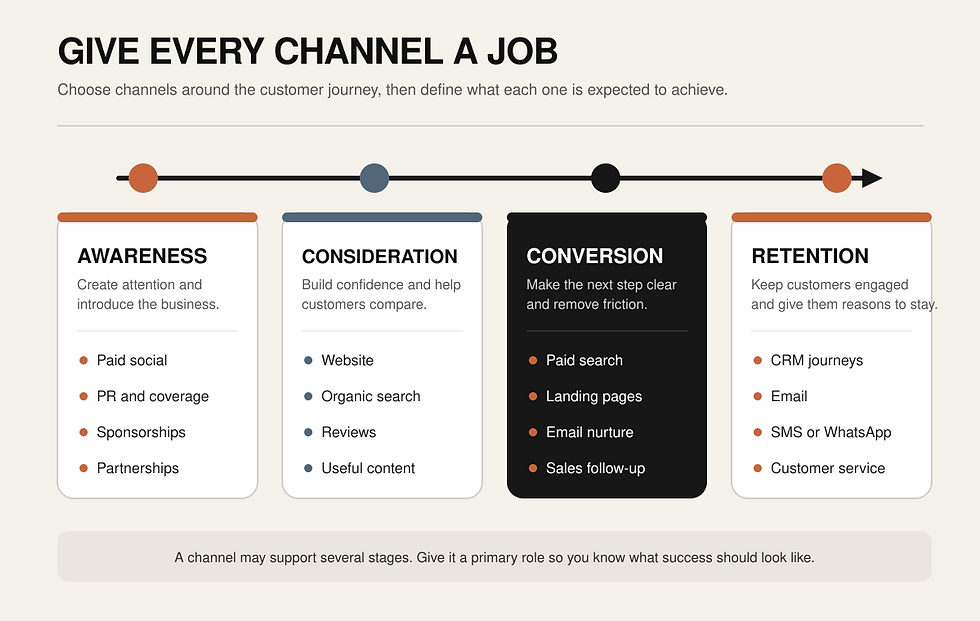
Every channel needs a job
Different marketing channels are good at different things.
Paid social can introduce a business to new audiences. Search can capture existing demand. Email can nurture leads and encourage customers to return. LinkedIn can build professional credibility. Events can develop relationships that are difficult to create through a screen.
Problems arise when every channel is expected to do everything. A business publishes an educational Instagram post and judges it entirely by immediate sales. It sends one promotional email and decides email marketing does not work. It invests in brand activity but only measures last-click conversions.
The channel may not have failed. It may have been given the wrong job or measured against the wrong outcome.
Each channel should have a defined role within the wider customer journey.
For example:
Paid advertising might generate awareness or capture enquiries.
Social media might demonstrate expertise and keep the brand visible.
Search might help customers find the business when they are actively looking for a solution.
Email might turn early interest into a purchase and support retention.
The website might build confidence and convert demand.
Partnerships might provide access to a relevant audience through an established relationship.
Direct mail might help the business stand out in a market where every competitor is fighting for attention online.
These roles will vary by business. The important part is being able to explain why each channel exists. If nobody can explain its purpose, target audience or contribution, it may be activity the business has inherited rather than activity it still needs.
Choose channels around the customer journey
Businesses sometimes choose channels based on what is popular, what competitors are doing or what the internal team enjoys producing.
Customers tend to be less interested in the marketing department’s preferences.
A better approach is to look at how people actually make a decision.
Consider:
Where do customers first become aware of the problem?
Where do they discover possible solutions?
How do they research and compare businesses?
What gives them confidence to enquire or buy?
What happens if they are interested but not ready?
How does the business remain useful after the purchase?
What encourages them to return or recommend it?
Different channels can then be assigned to the stages where they are most useful. A potential customer might first hear about a business through a recommendation, search for it on Google, read reviews, visit the website and join the mailing list. They may then receive a useful email that prompts them to make an enquiry.
Which channel generated the customer? The honest answer is probably all of them.
The referral created awareness. Search helped them find the business. Reviews provided reassurance. The website explained the offer. Email kept the business visible until the timing was right.
This is why looking at channels in isolation gives an incomplete picture. Customers rarely experience marketing in the neat sequence shown in a presentation. They move backwards and forwards, compare options and disappear for a while before returning when they are ready.
The strategy needs to account for that.
You do not need to be everywhere
“You need to be where your customers are” is common marketing advice. It is not wrong, but it is usually incomplete.
Your customers are probably in many places. That does not mean your business needs an active presence in all of them.
A company could potentially use Instagram, Facebook, TikTok, LinkedIn, YouTube, Pinterest, podcasts, email, direct mail, search advertising, display advertising, events, sponsorships and public relations.
Attempting to do all of that with a small team and limited budget is not ambitious. It is a good way to become inconsistent across fourteen different channels.
Channel selection needs to account for:
Whether the target audience uses the channel in a relevant context
The role the channel will play
The cost of maintaining it properly
The type of content or resource it requires
How long it is likely to take before results appear
Whether the business can measure its contribution
Whether another channel could achieve the same goal more effectively
There is also a difference between a customer using a platform and being receptive to your business on it. Someone may spend two hours a day on TikTok. That does not automatically mean they want tax advice, industrial equipment or commercial property services between videos of dogs and people arguing about air fryers.
Audience presence matters. Audience intent matters more.
Do fewer things properly
Focusing on fewer channels does not mean thinking smaller. It means giving the chosen channels enough attention to work.
A strong email programme requires more than an occasional newsletter. It may involve segmentation, automated journeys, relevant campaigns, testing and a clear plan for growing the database.
A useful social presence requires more than copying the same post across several platforms. It needs a recognisable point of view, appropriate formats and enough consistency for the audience to remember the business.
Paid advertising needs a suitable offer, accurate tracking, strong creative and a customer journey that can convert the traffic.
Every channel carries a resource cost, even when using it is technically free.
The cost might be time, content production, management, training, software or attention. Businesses rarely include all of those costs when deciding to add another platform. They should.
One well-managed channel that reaches the right people is more valuable than five channels being maintained out of obligation.
Do not overlook the channels you own
Businesses often put considerable effort into building audiences on platforms they do not control. Social platforms are useful, but access to the audience is governed by algorithms, advertising products and rules that can change.
An email database, CRM and direct customer relationship give the business far more control.
That does not mean abandoning social media. It means using rented channels to help strengthen owned ones. A social follower can become an email subscriber. A website visitor can become an enquiry. A first-time customer can enter a useful post-purchase journey. An old customer can be reactivated with a relevant message.
This is where channel strategy and CRM should connect.
If marketing successfully attracts attention but the business has no structured way to capture, nurture or retain that interest, it will keep paying to reach similar people again.
Acquisition is important. Continually starting from zero is expensive.
When should you add a new marketing channel?
Adding a new channel can be the right decision. The test is whether there is a clear commercial reason for doing it. A new channel might be justified when:
A valuable audience is active there
Customer behaviour has changed
The existing mix has a clear gap
The channel can perform a specific role better
The business has enough resource to manage it properly
There is a realistic plan for content, measurement and ownership
Existing channels are already operating effectively
“Everyone else is doing it” is not a strong enough reason. Neither is “we should probably be on there”. Before launching a new channel, the business should be able to answer five questions:
Who are we trying to reach?
What job will this channel perform?
What will we consistently produce or deliver?
Who will be responsible for it?
How will we decide whether it is working?
If those questions cannot be answered, the channel is not ready to launch.
Review what you already have
Before adding anything new, review the current marketing mix. For each channel, record:
Its purpose
The audience it serves
The stage of the customer journey it supports
The time and money invested
The results it produces
The person responsible
Whether it should be improved, reduced or removed
This often reveals several problems. Two channels may be performing the same role. An important stage of the customer journey may have no support at all. A large amount of time may be going into activity that nobody measures. A high-performing channel may be receiving less attention than one the business simply enjoys using.
The answer may be to add something. It may also be to stop doing three other things and put the time into the channel that is already showing potential. That can feel uncomfortable. Businesses become attached to activity, particularly when someone has invested time in building it. But continuing to spend time on ineffective marketing does not recover the original investment. It just adds to it.
Clarity before channels
A good marketing strategy does not try to use every available channel. It selects the channels that support the commercial objective, gives each one a clear role and connects them around the customer journey.
That creates a better question than “Where else should we be marketing?” Ask:
What are we trying to achieve?
Who are we trying to reach?
What does that person need at each stage?
Which channels can deliver that most effectively?
What can we realistically manage well?
What should we stop doing?
The business may still decide to launch a podcast, start using TikTok or invest in paid search.
The difference is that the decision will have a reason behind it.
BLACK WOLF DIGITAL helps businesses turn disconnected marketing activity into a clearer, commercially focused plan. That includes reviewing existing channels, understanding the customer journey and deciding where time and budget can make the greatest difference.
Because your marketing does not need to be everywhere.
It needs to work.


Comments